Vietnam War Protests: Shifting US Public Opinion by 1975
Five major anti-Vietnam War protests significantly altered US public opinion by 1975, demonstrating the power of collective action to influence policy and shape national discourse.
Por: Marcelle em 23 de setembro de 2026
Five major anti-Vietnam War protests significantly altered US public opinion by 1975, demonstrating the power of collective action to influence policy and shape national discourse.
The Vietnam War’s Domestic Fallout: How 5 Major Protests Shifted Public Opinion by 1975 is a critical chapter in American history, revealing the profound impact of citizen dissent on national policy. As the conflict escalated and casualties amounted, a burgeoning anti-war movement took to the streets, transforming the political landscape and ultimately influencing the withdrawal of U.S. forces. This article delves into five pivotal protests that galvanized public sentiment, compelling a nation to reconsider its involvement.
The March on the Pentagon (October 1967)
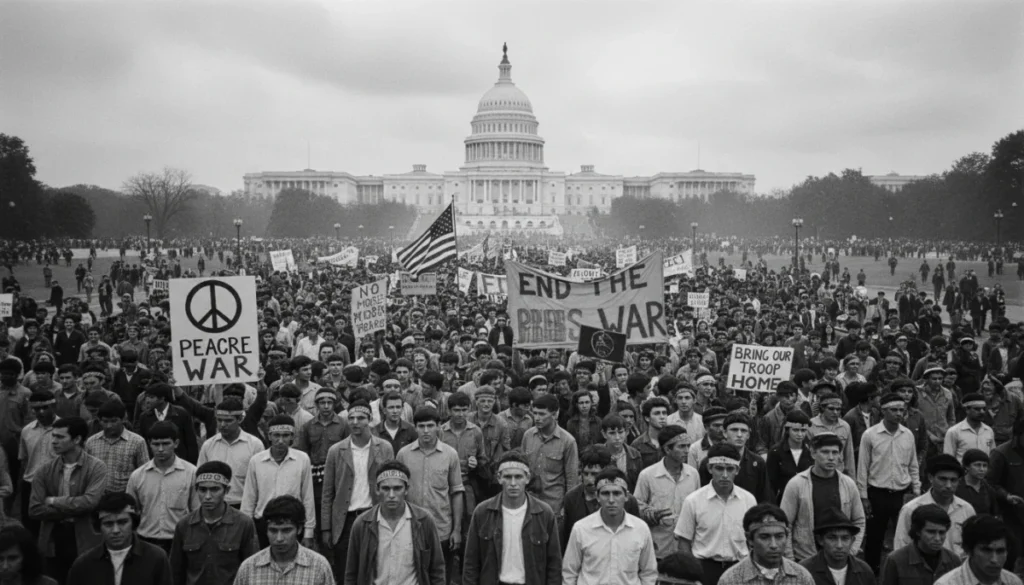
The March on the Pentagon in October 1967 marked a significant escalation in the anti-war movement, moving from localized demonstrations to a direct confrontation with the symbols of military power. Organized by the National Mobilization Committee to End the War in Vietnam, this protest drew tens of thousands to Washington D.C., creating a powerful visual spectacle of dissent.
Participants converged on the Pentagon, intending to “exorcise” the building and symbolically shut down the war machine. The event was characterized by a mix of peaceful protest, civil disobedience, and intense clashes with military police and federal marshals.
Symbolism and Confrontation
The march was not merely a demonstration; it was a carefully orchestrated act of political theater designed to capture national attention. Activists like Jerry Rubin and Abbie Hoffman employed creative tactics to highlight their message.
Symbolic Actions: Attempts to levitate the Pentagon and place flowers in soldiers’ rifle barrels.
Media Coverage: Extensive media presence ensured the images and stories reached homes across America.
Direct Confrontation: Thousands attempted to storm the Pentagon, leading to arrests and injuries.
The stark images of protestors clashing with armed soldiers and the sheer number of participants forced many Americans to confront the growing division within the country regarding the war. It shattered the illusion of unified support for the government’s policies, making it clear that a substantial portion of the population was vehemently opposed to the conflict.
In essence, the March on the Pentagon served as a dramatic turning point, transforming the anti-war movement from a fringe element into a mainstream force. Its raw imagery and direct challenge to authority resonated deeply, contributing to a broader public questioning of the war’s legitimacy and the government’s handling of the crisis.
The Moratorium to End the War in Vietnam (October 1969)
Two years after the Pentagon march, the Moratorium to End the War in Vietnam in October 1969 represented a shift in protest strategy, emphasizing widespread, decentralized action rather than a single, large-scale confrontation. This national demonstration called for a cessation of business as usual, encouraging citizens across the country to participate in local teach-ins, rallies, and vigils.
Millions of Americans took part, making it the largest anti-war demonstration in U.S. history. The Moratorium aimed to show the breadth and depth of opposition to the war, extending far beyond the typical activist circles.
Grassroots Mobilization and Widespread Participation
Unlike previous protests concentrated in major cities, the Moratorium engaged communities from coast to coast. This decentralized approach proved incredibly effective in demonstrating the sheer volume of public discontent.
Local Events: Universities, towns, and cities organized their own anti-war activities.
Diverse Participants: Students, professionals, religious leaders, and ordinary citizens joined the call for peace.
Educational Focus: Teach-ins provided platforms for discussing the war’s moral and economic costs.
The Moratorium’s success lay in its ability to transcend traditional protest demographics, involving a broader spectrum of American society. This widespread participation sent an undeniable message to Washington: the anti-war sentiment was not isolated but deeply embedded within the national consciousness.
The sheer scale of the Moratorium compelled President Nixon to acknowledge the movement, though he publicly dismissed its influence. Privately, however, the administration recognized the growing pressure, and the event contributed to a slowing of troop deployments and a reevaluation of war strategies. It underscored that public opinion was increasingly turning against the conflict, making it politically untenable to ignore.
Kent State and Jackson State Shootings (May 1970)
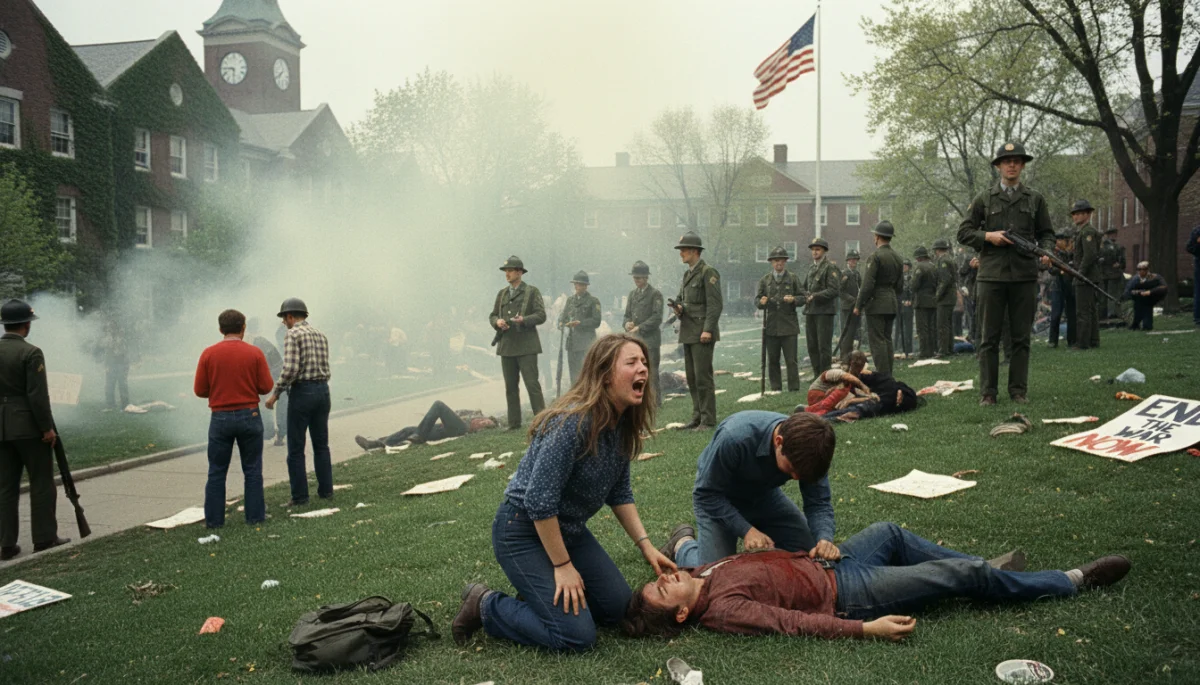
The events of May 1970 at Kent State University in Ohio and Jackson State College in Mississippi marked a tragic and pivotal moment, profoundly shocking the nation and further intensifying the anti-war movement. These incidents, occurring within days of each other, involved the use of lethal force by authorities against unarmed student protestors.
At Kent State, National Guard troops opened fire on students protesting the Cambodian Incursion, killing four and wounding nine. Days later, at Jackson State, police killed two students and injured twelve during protests against racial injustice and the Vietnam War.
Escalation of Violence and Public Outcry
The killings at Kent State and Jackson State ignited a firestorm of outrage across the country. For many, these events symbolized the government’s willingness to use extreme force against its own citizens, particularly students.
National Strikes: Over 4 million students participated in strikes and protests at hundreds of colleges and universities.
Media Impact: Iconic photographs, particularly of the Kent State victims, became powerful symbols of government overreach.
Deepening Divisions: The events further polarized American society, with some condemning the students and others expressing profound horror.
The Kent State and Jackson State shootings transformed the perception of the anti-war movement. What had been seen by some as a radical fringe was now tragically victimized by state violence, making it more sympathetic to a wider segment of the population. The incidents forced many moderate Americans to question the morality and direction of the war, as well as the government’s response to dissent.
These tragedies served as a stark reminder of the human cost of political conflict, not just on the battlefield but also on American soil. They undeniably shifted public opinion, eroding trust in government and amplifying calls for an end to the war, contributing significantly to the sense of domestic fallout from the Vietnam War.
The Vietnam Veterans Against the War (VVAW) Protests (1971)
By 1971, the anti-war movement gained a powerful new voice: Vietnam Veterans Against the War (VVAW). Composed of former servicemen who had experienced the conflict firsthand, VVAW brought an undeniable moral authority to the protest movement. Their demonstrations, particularly the Winter Soldier Investigation and Dewey Canyon III, shattered the myth of unwavering soldier support for the war and exposed the brutal realities of combat.
These veterans, many of whom had been decorated for their service, publicly denounced the war as immoral and unjust, sharing harrowing testimonies of atrocities and the psychological toll of fighting.
Moral Authority and Shocking Testimonies
The VVAW protests were unique because they came from within the military establishment, making their message particularly difficult for the government to dismiss as mere radicalism. Their testimonies were raw and unfiltered.
Winter Soldier Investigation: Veterans recounted war crimes and atrocities committed by American forces.
Dewey Canyon III: Veterans threw their medals and ribbons onto the steps of the U.S. Capitol.
Public Sympathy: Their actions garnered immense sympathy and respect from a public increasingly disillusioned with the war.
The sight of decorated veterans condemning the war and symbolically rejecting their honors was a profoundly moving and impactful moment for the American public. It challenged the narrative that soldiers were uniformly supportive of the mission and highlighted the deep moral crisis the war had created.
VVAW’s actions significantly eroded public confidence in the war’s objectives and conduct. Their firsthand accounts provided irrefutable evidence of the war’s brutality, making it harder for the government to maintain public support. This powerful veteran-led dissent was instrumental in turning more Americans against the conflict, contributing to the broader shift in public opinion.
The Pentagon Papers Leak and Protests (1971)
The release of the Pentagon Papers in June 1971 by Daniel Ellsberg, a former military analyst, represented a monumental blow to government credibility and further fueled the anti-war movement. This top-secret study revealed decades of government deception regarding U.S. involvement in Vietnam, exposing a systematic misleading of the American public and Congress.
The leak, published first by The New York Times and then other major newspapers, detailed how successive administrations had expanded the war despite internal doubts and without full transparency.
Government Deception Exposed and Public Distrust
The Pentagon Papers confirmed what many protestors had long suspected: the government had not been truthful about the war’s origins, objectives, and prospects for success. This revelation caused a massive crisis of confidence.
Media Frenzy: The papers dominated headlines, sparking widespread public debate and outrage.
Legal Battles: The Nixon administration’s attempts to block publication led to a landmark Supreme Court case affirming press freedom.
Erosion of Trust: Public trust in government institutions plummeted as the extent of official deception became clear.
The Pentagon Papers provided concrete, documented proof of governmental deceit, validating the anti-war movement’s claims and galvanizing public opposition. It was a watershed moment that solidified public distrust in official pronouncements about the war.
The revelations made it nearly impossible for the government to credibly defend its continued involvement in Vietnam. The public, feeling betrayed, became even more receptive to calls for immediate withdrawal. This exposure of truth undeniably accelerated the shift in public opinion, making the war increasingly unpopular and politically unsustainable, thereby contributing significantly to the Vietnam War’s Domestic Fallout: How 5 Major Protests Shifted Public Opinion by 1975.
Impact on Public Opinion and Policy by 1975
By 1975, the cumulative effect of these major protests and other forms of dissent had undeniably transformed American public opinion regarding the Vietnam War. What began as a relatively small movement grew into a powerful national force that significantly impacted policy decisions. The shift was not just about opposition to the war itself, but a broader questioning of government authority and military interventionism.
Public sentiment moved from initial support, or at least tolerance, to widespread disillusionment and outright demand for withdrawal. This change was reflected in polling data, media coverage, and political discourse.
From Dissent to Policy Change
The constant pressure from the anti-war movement, amplified by pivotal events, made it politically unfeasible for the government to continue the war indefinitely. The public’s sustained opposition played a crucial role in shaping the eventual outcome.
Congressional Pressure: Growing public sentiment translated into increased pressure on Congress to limit presidential war powers and cut funding.
Withdrawal Acceleration: The Nixon administration, despite its rhetoric, was ultimately forced to accelerate the withdrawal of troops.
War Powers Act: The public’s desire for greater accountability led to the passage of the War Powers Act of 1973, limiting the president’s ability to commit troops without congressional approval.
The anti-war movement’s persistent efforts, combined with the ethical and human costs revealed by events like Kent State and the Pentagon Papers, created an environment where ending the war became a domestic imperative. By 1975, when Saigon fell, a significant majority of Americans simply wanted the conflict to be over, regardless of the perceived outcome. The protests had successfully shifted the national conversation from winning the war to ending it.
This profound change in public opinion demonstrated the power of collective action in a democracy. It showed that sustained, visible dissent could force a government to change course, even on deeply entrenched foreign policy issues. The legacy of these protests continues to influence American political thought and the public’s role in foreign policy debates.
Key Protest Event
Impact on Public Opinion
March on the Pentagon (1967)
Demonstrated significant, organized anti-war sentiment, challenging government authority.
Moratorium to End the War (1969)
Showcased widespread, national opposition, moving anti-war sentiment mainstream.
Kent/Jackson State Shootings (1970)
Shocked the nation, eroding trust in government and amplifying calls for peace.
Pentagon Papers Leak (1971)
Exposed government deception, deeply undermining public confidence and support for the war.
Frequently asked questions about Vietnam War protests
What was the primary goal of the anti-Vietnam War protests?▼
The primary goal of the anti-Vietnam War protests was to pressure the U.S. government to withdraw its troops from Vietnam and end military involvement. Protestors highlighted moral objections, the high human cost, and the perceived futility of the conflict, aiming to shift public and political will towards peace.
How did the Kent State shootings affect the anti-war movement?▼
The Kent State shootings dramatically intensified the anti-war movement by galvanizing public outrage against government violence. The tragic deaths of unarmed students led to widespread university strikes and protests, deepening societal divisions and eroding trust in official responses to dissent, making the war even more unpopular.
What role did Vietnam veterans play in the protests?▼
Vietnam veterans, particularly through groups like VVAW, played a crucial role by lending moral authority to the anti-war cause. Their firsthand accounts of atrocities and their symbolic rejection of medals profoundly impacted public perception, demonstrating that opposition to the war was not limited to civilian radicals but included those who had served.
How did the Pentagon Papers change public opinion?▼
The Pentagon Papers exposed decades of government deception regarding U.S. involvement in Vietnam, confirming public suspicions of official dishonesty. This revelation severely undermined public trust in the government’s credibility, fueling widespread disillusionment and strengthening calls for an immediate end to the war.
What was the ultimate impact of these protests by 1975?▼
By 1975, the cumulative effect of these protests had profoundly shifted public opinion, making the Vietnam War politically unsustainable. This widespread public pressure contributed significantly to the U.S. withdrawal, the passage of the War Powers Act, and a lasting legacy of skepticism towards governmental military interventions.
Conclusion
The journey from widespread public support, or at least passive acceptance, to fervent opposition against the Vietnam War was a complex and often painful one for the United States. The five major protest movements—the March on the Pentagon, the Moratorium, the Kent State and Jackson State shootings, the VVAW protests, and the Pentagon Papers leak—each played a distinct yet interconnected role in shaping this profound shift in national sentiment. By 1975, the relentless pressure from an increasingly unified anti-war movement, coupled with tragic events and revelations of governmental deceit, had irrevocably altered the American public’s perception of the conflict. This domestic fallout not only led to the eventual withdrawal of U.S. forces but also left an indelible mark on American society, fostering a deep-seated skepticism towards foreign interventions and reinforcing the power of citizen activism in a democratic nation. The legacy of these protests continues to resonate, reminding us of the critical role public opinion plays in shaping the course of history.