Cold War’s Early Years: US Containment Strategies by 1960
By 1960, US foreign policy was fundamentally shaped by key containment strategies like the Truman Doctrine and NATO, designed to counter Soviet expansionism and define America's role in a bipolar world.
Por: Marcelle em 23 de setembro de 2026
The United States adopted several key strategies by 1960, including the Truman Doctrine and NATO, to counter Soviet expansionism and prevent the spread of communism during the nascent stages of the Cold War.
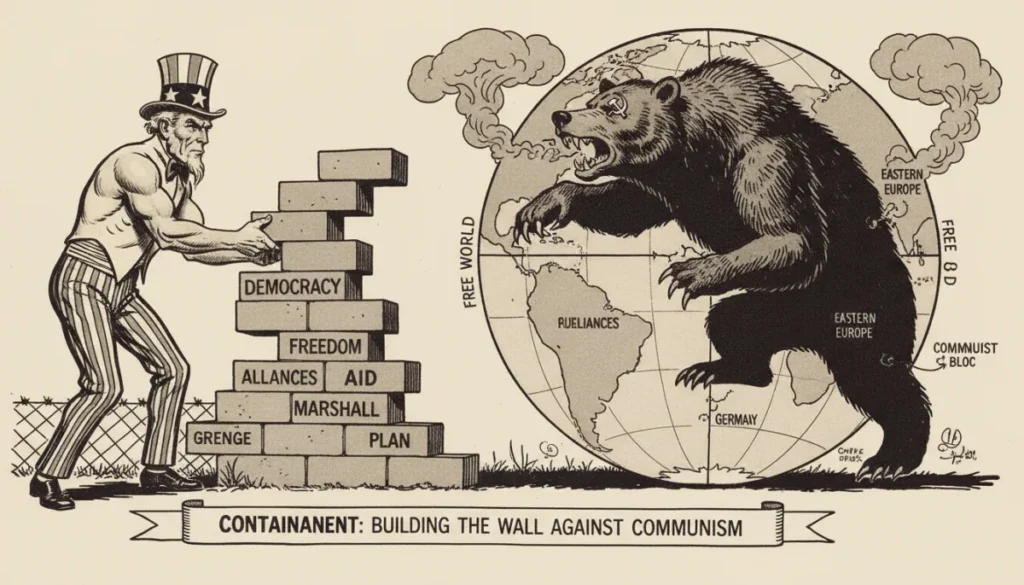
The dawn of the Cold War ushered in an unprecedented era of geopolitical tension, forcing the United States to redefine its foreign policy radically. The period between the end of World War II and 1960 was critical, as the ideological clash between capitalism and communism intensified. It was during these formative years that the concept of Cold War containment strategies emerged as the cornerstone of American international relations, aiming to prevent the spread of Soviet influence without direct military confrontation. Understanding these foundational policies is essential to grasping the trajectory of 20th-century history and beyond.
The Truman Doctrine: A Declaration of Ideological War
The Truman Doctrine, announced in March 1947, marked a definitive shift in American foreign policy, moving away from isolationism and toward active global engagement. This doctrine was a direct response to perceived Soviet threats in Greece and Turkey, where communist insurgencies threatened to destabilize pro-Western governments. President Harry S. Truman articulated a commitment to supporting free peoples resisting attempted subjugation by armed minorities or outside pressures.
This policy was not merely about military aid; it was a broad declaration of ideological opposition to communism, framing the global conflict as a struggle between two irreconcilable ways of life. The immediate impact was the provision of substantial financial and military assistance to Greece and Turkey, successfully preventing their fall to communist forces. More broadly, it established a precedent for American intervention in conflicts far from its borders, laying the groundwork for future containment efforts.
The Doctrine’s Core Tenets
The Truman Doctrine established several fundamental principles that would guide US foreign policy for decades. It posited that the United States had a moral and strategic obligation to protect democratic nations from communist aggression, whether internal or external. This commitment extended beyond direct military involvement to include economic and political support.
Financial Aid: Providing economic assistance to vulnerable nations to bolster their economies and reduce the appeal of communism.
Military Support: Supplying arms, training, and military advisors to governments facing communist threats.
Ideological Stance: Clearly articulating a global ideological battle between freedom and totalitarianism.
Global Scope: Establishing a precedent for US intervention wherever communism threatened to expand.
The doctrine effectively drew a line in the sand, signaling to the Soviet Union that the United States would actively resist its expansionist ambitions. It transformed American foreign policy from one of reactive engagement to proactive intervention, setting the stage for a prolonged global rivalry. The success in Greece and Turkey was seen as validation, reinforcing the belief that robust intervention could halt communist advances.
The Marshall Plan: Rebuilding Europe, Containing Communism
Following the Truman Doctrine, the Marshall Plan, officially known as the European Recovery Program, was introduced in June 1947. This ambitious economic aid package aimed to rebuild war-torn Western European economies, which were struggling to recover from the devastation of World War II. The rationale behind the plan was two-fold: humanitarian concern for suffering populations and a strategic imperative to prevent the rise of communist influence in economically vulnerable nations.
Secretary of State George C. Marshall proposed a comprehensive program of financial assistance, inviting all European nations, including the Soviet Union and its satellites, to participate. However, the Soviet Union rejected the offer, viewing it as a blatant attempt by the US to exert economic and political control over Europe. This rejection further solidified the division of Europe into two distinct blocs.
Over four years, the United States poured over $13 billion (equivalent to over $150 billion today) into Western European economies. This aid helped to modernize industrial infrastructure, restore agricultural production, and stabilize financial systems. The economic recovery fostered by the Marshall Plan significantly reduced social unrest and the appeal of communist parties in countries like France and Italy, which had strong communist movements.
Economic Stability as a Shield
The Marshall Plan’s success demonstrated that economic stability could be a powerful tool in the arsenal of containment. By alleviating poverty and promoting prosperity, the United States effectively inoculated Western Europe against the perceived allure of communist ideology. The plan also fostered greater economic integration and cooperation among European nations, laying the groundwork for future alliances.
Economic Recovery: Revitalized industries and agriculture across Western Europe.
Political Stability: Reduced social unrest and diminished the influence of communist parties.
Trade Expansion: Created new markets for American goods and strengthened transatlantic economic ties.
Alliance Building: Fostered cooperation among recipient nations, paving the way for military alliances.
The Marshall Plan was a highly successful example of soft power, demonstrating that economic strength could be as effective as military might in achieving foreign policy objectives. It cemented America’s role as a global economic leader and a benefactor to war-ravaged nations, contrasting sharply with the Soviet Union’s more coercive approach to its satellite states.
NATO: A Collective Security Alliance
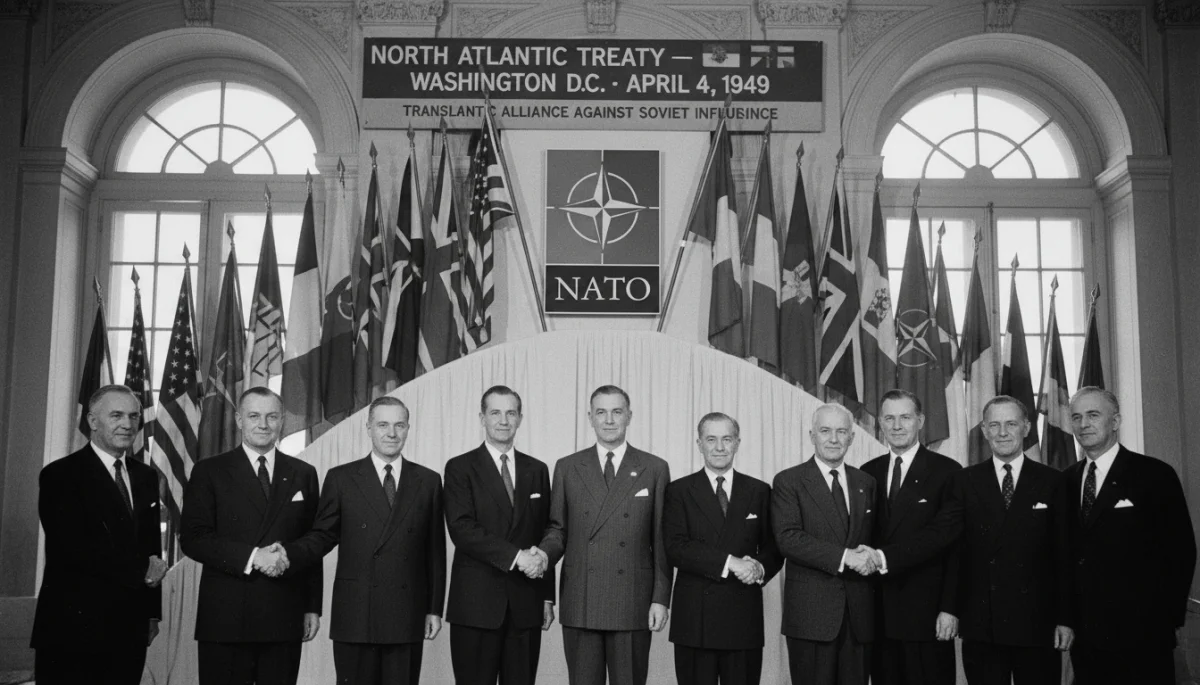
The formation of the North Atlantic Treaty Organization (NATO) in April 1949 represented a crucial military dimension to the containment strategy. While the Truman Doctrine and Marshall Plan addressed ideological and economic threats, NATO provided a collective security framework to deter potential Soviet military aggression in Western Europe. The Berlin Blockade of 1948-1949 had underscored the very real threat of Soviet military expansion, prompting Western nations to seek a more formal defense arrangement.
Initially comprising 12 member states, including the United States, Canada, and several Western European nations, NATO established the principle of collective defense: an attack on one member would be considered an attack on all. This commitment, enshrined in Article 5 of the North Atlantic Treaty, provided a powerful deterrent against Soviet aggression, effectively drawing a military line in Europe.
Deterrence Through Unity
NATO’s creation signaled a permanent American military presence in Europe, a radical departure from its pre-war isolationist stance. The alliance provided a unified command structure and facilitated military cooperation and standardization among its members. This collective strength was intended to offset the numerical superiority of the Soviet Red Army and prevent any unilateral Soviet moves into Western Europe.
Collective Defense: An attack on one member is an attack on all, ensuring mutual military support.
Military Integration: Fostered cooperation, joint exercises, and standardized equipment among member states.
Deterrence: Presented a credible military threat to any potential Soviet aggression.
Transatlantic Link: Solidified the political and military ties between North America and Western Europe.
The establishment of NATO fundamentally altered the geopolitical landscape, creating a powerful Western bloc united against the Soviet Union. It solidified the division of Europe and contributed to the militarization of the Cold War, leading to the formation of the Warsaw Pact by the Soviet Union and its allies in 1955 as a direct countermeasure. NATO proved to be one of the most enduring and successful containment strategies.
NSC-68: The Blueprint for Massive Rearmament
The National Security Council Report 68 (NSC-68, declassified in 1975 but adopted in 1950, was a pivotal document that profoundly influenced US Cold War policy and military spending. This highly influential report argued that the Soviet Union was inherently expansionist and posed an existential threat to the free world. It advocated for a massive increase in military expenditure and a more aggressive, globalized approach to containment, moving beyond solely economic and political means.
NSC-68 shifted the perception of the Soviet threat from a regional issue to a global ideological confrontation, requiring a comprehensive and sustained response. The report called for significantly increased defense budgets, the development of advanced nuclear weapons, and the strengthening of alliances worldwide. The outbreak of the Korean War in June 1950 provided immediate justification for its recommendations, leading to a rapid implementation of its proposals.
A Global Military Stance
The recommendations of NSC-68 transformed the US military and its role in global affairs. It led to a dramatic increase in defense spending, the expansion of conventional forces, and the acceleration of the nuclear arms race. This shift indicated a move towards a more militarized containment strategy, ready to confront communism wherever it appeared, not just in Europe.
Increased Defense Spending: Advocated for substantial increases in the military budget.
Global Military Presence: Called for strengthening US military capabilities and alliances worldwide.
Nuclear Deterrence: Emphasized the development and maintenance of a strong nuclear arsenal.
Proactive Engagement: Promoted a more assertive and interventionist foreign policy.
NSC-68 effectively set the stage for decades of high military spending and a global network of US military bases and alliances. It solidified the idea that containment required not just economic aid and diplomatic pressure, but also overwhelming military superiority. This document became the strategic blueprint for the US approach to the Cold War for the next two decades, profoundly shaping its military-industrial complex.
The Eisenhower Doctrine: Extending Containment to the Middle East
As the Cold War progressed, the focus of containment expanded beyond Europe to other strategically vital regions. The Eisenhower Doctrine, announced in January 1957, specifically extended US military and economic aid to Middle Eastern nations threatened by communist aggression. This doctrine was a direct response to the Suez Crisis of 1956, which highlighted the declining influence of traditional European powers in the region and the growing vacuum that the Soviet Union seemed poised to fill.
President Dwight D. Eisenhower, recognizing the strategic importance of the Middle East due to its vast oil reserves and proximity to the Soviet Union, sought to prevent Soviet encroachment. The doctrine authorized the President to use US armed forces to assist any nation in the region requesting aid against overt armed aggression from any nation controlled by international communism. It also allowed for the provision of economic and military assistance.
Protecting Vital Interests
The Eisenhower Doctrine marked a significant expansion of the containment strategy, demonstrating America’s willingness to project its power and influence into new theaters. The first practical application of the doctrine came in 1958 when US Marines were deployed to Lebanon at the request of its government, which feared a pro-Soviet coup. This intervention successfully stabilized the situation without direct conflict with the Soviet Union.
Regional Focus: Specifically targeted the Middle East as a new front in the Cold War.
Military Intervention: Authorized the use of US armed forces to counter communist aggression.
Economic & Military Aid: Provided assistance to strengthen regional allies.
Strategic Importance: Recognized the Middle East’s critical role due to oil and geography.
The Eisenhower Doctrine solidified the notion that containment was a flexible and adaptable policy, capable of addressing communist threats in diverse geopolitical contexts. It underscored the US commitment to preventing Soviet expansion globally, even if it meant direct military intervention to protect strategic interests and emerging nations from falling under communist influence. By 1960, this doctrine had firmly established the Middle East as another crucial arena in the Cold War.
Covert Operations and Proxy Wars: The Shadowy Side of Containment
Beyond the highly publicized doctrines and alliances, a significant aspect of Cold War containment involved covert operations and proxy wars, particularly during the 1950s. The Central Intelligence Agency (CIA), established in 1947, played a crucial role in implementing these clandestine strategies. These operations aimed to undermine communist influence, support anti-communist regimes, and prevent the rise of pro-Soviet governments without direct, overt US military involvement.
These actions often involved supporting opposition movements, orchestrating coups, and engaging in psychological warfare. The logic was that direct military confrontation with the Soviet Union carried unacceptable risks, given the advent of nuclear weapons. Covert actions offered a way to fight the Cold War in the shadows, achieving strategic objectives with deniable involvement.
Undermining Communist Influence
Notable examples of covert operations include the 1953 Iranian coup, which restored the Shah to power and protected Western oil interests, and the 1954 Guatemalan coup, which overthrew a democratically elected government perceived as pro-communist. These interventions, while achieving short-term containment goals, often had long-term destabilizing effects and drew criticism for undermining democratic processes.
CIA Interventions: Utilized intelligence agencies for clandestine operations.
Regime Change: Supported or orchestrated coups to install anti-communist governments.
Financial & Military Aid: Provided secret assistance to anti-communist forces globally.
Proxy Conflicts: Engaged in conflicts through third parties to avoid direct superpower confrontation.
The use of covert operations became an increasingly common tool in the US containment strategy throughout the 1950s. While often effective in preventing immediate communist gains, these actions also contributed to a climate of mistrust and anti-American sentiment in various regions. By 1960, the shadowy world of espionage and covert intervention was an undeniable, if controversial, component of America’s broader effort to contain communism globally.
Key Strategy
Brief Description
Truman Doctrine
Provided military and economic aid to nations resisting communism, notably Greece and Turkey.
Marshall Plan
Massive economic aid to rebuild Western Europe, preventing communist political gains.
NATO
Collective security alliance forming a military deterrent against Soviet aggression in Europe.
Eisenhower Doctrine
Extended military and economic aid to Middle Eastern nations threatened by communism.
Frequently asked questions about Cold War Containment
What was the primary goal of Cold War containment strategies?▼
The primary goal of Cold War containment strategies was to prevent the spread of communism beyond its existing borders, particularly Soviet influence, without engaging in direct military confrontation that could lead to a nuclear war. This involved political, economic, and military measures.
How did the Marshall Plan contribute to containment?▼
The Marshall Plan provided massive economic aid to rebuild war-torn Western European economies. By fostering economic stability and prosperity, it aimed to reduce the appeal of communist ideologies in these vulnerable nations, thereby containing Soviet political influence effectively.
What role did NATO play in US foreign policy by 1960?▼
By 1960, NATO served as the cornerstone of US military containment policy in Europe. It was a collective security alliance that deterred Soviet aggression by pledging mutual defense among its member states, ensuring a unified Western response to any attack.
What was the significance of the Eisenhower Doctrine?▼
The Eisenhower Doctrine extended the containment strategy to the Middle East, authorizing US military and economic aid to nations threatened by communist aggression in that region. It highlighted the global reach of US commitment to preventing Soviet expansion.
Were covert operations a part of early containment efforts?▼
Yes, covert operations conducted by the CIA were a significant, though often controversial, part of early containment. These clandestine actions aimed to undermine communist influence and support anti-communist regimes without direct, overt US military involvement, particularly in regions like Iran and Guatemala.
Conclusion
The period between the end of World War II and 1960 witnessed the United States forge a comprehensive and multifaceted foreign policy centered on containing the spread of communism. From the ideological declaration of the Truman Doctrine to the economic revitalization of the Marshall Plan, the military deterrence of NATO, and the expanded regional focus of the Eisenhower Doctrine, these strategies collectively defined America’s approach to the burgeoning Cold War. Coupled with the more clandestine efforts of covert operations, these initiatives laid the enduring groundwork for US global engagement, profoundly shaping international relations and setting the stage for decades of geopolitical rivalry. Understanding these early containment strategies is crucial to appreciating the complexities of the Cold War era and its lasting impact on American foreign policy.