Manifest Destiny’s True Cost: Broken Treaties by 1890
This article examines the true cost of Manifest Destiny by analyzing four significant Indigenous American treaties that were systematically broken by the United States government before 1890, highlighting the profound and lasting consequences for Native nations.
Por: Marcelle em 23 de setembro de 2026
The true cost of Manifest Destiny’s True Cost: Examining 4 Indigenous American Treaties Broken by 1890 reveals a painful history of systematic betrayal, where the United States government repeatedly violated agreements with Native nations, leading to immense suffering and loss of ancestral lands and sovereignty.
The concept of Manifest Destiny, the 19th-century belief that American settlers were divinely ordained to expand across North America, profoundly shaped the nation’s territorial growth. However, this expansion came at an immeasurable cost, particularly for Indigenous American nations whose lands and sovereignty were systematically undermined. The period leading up to 1890, often considered the closing of the American frontier, is rife with examples of treaties made in bad faith and subsequently broken. This article delves into Manifest Destiny’s True Cost: Examining 4 Indigenous American Treaties Broken by 1890, shedding light on the profound betrayal and its enduring impact.
The Fort Laramie Treaty of 1868: A Promise Forsaken
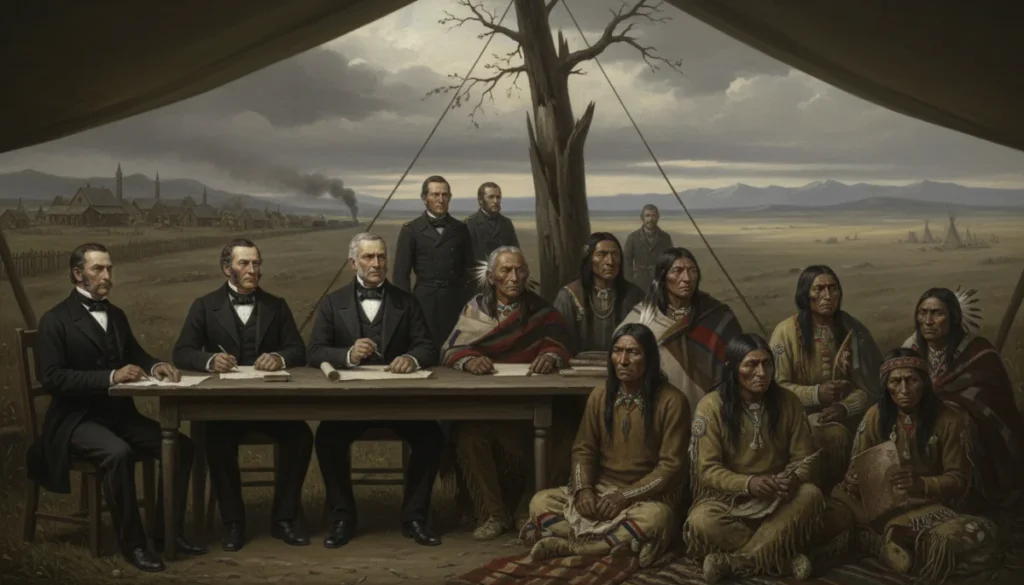
The Fort Laramie Treaty of 1868 stands as one of the most significant agreements between the United States and the Lakota, Dakota, and Arapaho nations. It was intended to establish lasting peace and define the Great Sioux Reservation, guaranteeing the Lakota ownership of the sacred Black Hills. However, the discovery of gold in the Black Hills just a few years later ignited a new wave of American expansionism, directly violating the solemn promises made in the treaty.
The treaty explicitly stated that the Great Sioux Reservation, including the Black Hills, was to be set aside for the absolute and undisturbed use and occupation of the Lakota. It also stipulated that no white person would be permitted to settle or pass through without the consent of the Indigenous nations. These provisions were critical for the preservation of Lakota culture and way of life, as the Black Hills held immense spiritual and cultural significance.
Gold Rush and Military Intervention
1874 Black Hills Expedition: General George Custer’s expedition confirmed gold in the Black Hills, triggering an immediate influx of prospectors and miners, directly breaching the treaty’s terms.
Government’s Failed Attempts: The U.S. government initially attempted to purchase the Black Hills, but the Lakota refused to sell their sacred lands.
Ultimatum and War: When negotiations failed, the government issued an ultimatum in 1876, demanding that all Lakota gather at agencies or be considered hostile, leading to the Great Sioux War.
The subsequent military campaigns, including the Battle of Little Bighorn, ultimately led to the Lakota’s defeat and the seizure of the Black Hills by Congress in 1877, without the required consent of three-fourths of the adult male Lakota population, as stipulated by the 1868 treaty. This act of unilateral abrogation demonstrated a clear disregard for Indigenous sovereignty and treaty obligations, leaving a legacy of injustice that continues to resonate today.
The breaking of the Fort Laramie Treaty of 1868 serves as a stark example of how the allure of natural resources and the pressure of westward expansion could swiftly dismantle solemn agreements, illustrating the true cost of Manifest Destiny for Indigenous communities.
The Treaty of New Echota (1835): Cherokee Removal and the Trail of Tears
The Treaty of New Echota, signed in 1835, is a deeply contentious document that led to the forced removal of the Cherokee Nation from their ancestral lands in the southeastern United States. This treaty was not recognized by the majority of the Cherokee people, yet it was ratified by the U.S. Senate, setting a dangerous precedent for disregarding legitimate Indigenous governance.
The Cherokee Nation had developed a sophisticated governmental structure, including a written constitution and a syllabary, demonstrating their capacity for self-governance. They had also adopted many aspects of American farming and social practices, believing this would protect their sovereignty. However, the discovery of gold on Cherokee land in Georgia intensified the demand for their removal, fueled by racial prejudice and land hunger.
Internal Division and External Pressure
A minority faction of the Cherokee, known as the Treaty Party, believed that resistance was futile and that the best course of action was to negotiate a removal treaty. Led by Elias Boudinot and Major Ridge, this group signed the Treaty of New Echota without the consent of the Principal Chief John Ross and the vast majority of the Cherokee Nation. The terms exchanged Cherokee lands in Georgia for new lands in Indian Territory (present-day Oklahoma) and financial compensation.
Lack of Legitimate Authority: The treaty was signed by individuals who did not represent the will of the Cherokee Nation, rendering it illegitimate in the eyes of the majority.
President Jackson’s Endorsement: President Andrew Jackson, a staunch advocate for Indian Removal, supported the treaty despite its controversial nature and the protests of the Cherokee Nation.
Supreme Court Ruling Ignored: The Supreme Court, in Worcester v. Georgia (1832), had affirmed Cherokee sovereignty, but Jackson famously defied the ruling.
The ratification of the Treaty of New Echota by the U.S. Senate, despite overwhelming Cherokee opposition, ultimately led to the forced removal known as the Trail of Tears in 1838. Thousands of Cherokee men, women, and children died during the brutal march, a tragic consequence of a broken treaty and the relentless pursuit of Manifest Destiny. This event remains a dark stain on American history, illustrating the devastating human cost of ignoring Indigenous rights and self-determination.
The Treaty of New Echota serves as a chilling reminder of how the U.S. government could exploit internal divisions and disregard the legitimate authority of Indigenous nations to achieve its expansionist goals, directly contributing to the brutal realities of broken indigenous treaties 1890.
The Medicine Lodge Treaty (1867): Plains Tribes Displaced
The Medicine Lodge Treaty, signed in 1867, involved the U.S. government and several Southern Plains tribes, including the Comanche, Kiowa, Apache, Cheyenne, and Arapaho. The primary aim was to confine these nomadic tribes to reservations in Indian Territory, paving the way for white settlement and railroad expansion across their traditional hunting grounds.
At the time, the Plains tribes were struggling with the decimation of the buffalo herds, their primary food source, due to overhunting by white settlers and railroad crews. The U.S. government leveraged this vulnerability, promising annuities, goods, and protection in exchange for vast tracts of land. The tribes, facing immense pressure and dwindling resources, reluctantly agreed to the terms.
Failed Promises and Continued Conflict
The treaty promised peace and guaranteed the tribes perpetual ownership of their new reservation lands. It also included provisions for schools, farming implements, and other resources to facilitate their transition to an agrarian lifestyle. However, these promises were rarely fully met, and the government’s failure to provide adequate supplies and protection quickly eroded trust.
Insufficient Supplies: The promised annuities and goods often arrived late, were of poor quality, or were insufficient to sustain the large populations on the reservations.
Continued Encroachment: Despite treaty guarantees, white settlers and buffalo hunters continued to trespass on reservation lands, further depleting resources and provoking conflict.
Military Incursions: The U.S. Army frequently violated reservation boundaries, pursuing tribal members who left the reservations to hunt or raid in response to the dire conditions.
The government’s inability or unwillingness to enforce its own treaty obligations led to renewed warfare across the Southern Plains, culminating in campaigns like the Red River War (1874-1875). This conflict effectively ended the Plains tribes’ independent way of life and solidified their confinement to reservations. The Medicine Lodge Treaty, though intended to bring peace, ultimately became another chapter in the story of broken indigenous treaties 1890, demonstrating the government’s consistent failure to uphold its word.
The tragic outcome of the Medicine Lodge Treaty highlights the severe consequences of land greed and broken promises, ultimately leading to the cultural and physical decimation of vibrant Indigenous communities on the Southern Plains.
The Nez Perce Treaty of 1855 and 1863: The Wallowa Valley Betrayal
The Nez Perce, known as the Nimiipuu, had a long history of peaceful relations with American settlers. The Treaty of 1855 established a vast reservation for them, encompassing much of their ancestral lands in present-day Oregon, Washington, and Idaho, including the cherished Wallowa Valley. This treaty was initially honored, and the Nez Perce continued their traditional lifestyle.
However, the discovery of gold in Nez Perce territory in the early 1860s once again triggered a land rush. The influx of miners and settlers led to intense pressure on the U.S. government to reduce the size of the Nez Perce reservation. This pressure culminated in the Treaty of 1863, often referred to as the “Thief Treaty” by the Nez Perce.
The “Thief Treaty” and Forced Removal
The Treaty of 1863 drastically reduced the Nez Perce reservation to a mere tenth of its original size, excluding the Wallowa Valley—the ancestral home of Chief Joseph’s band. This treaty was signed by a minority of Nez Perce chiefs, primarily those who had converted to Christianity and lived near the agency, and was not recognized by Chief Joseph and the non-treaty bands.
Lack of Consent: Chief Joseph and other non-treaty chiefs vehemently rejected the 1863 treaty, arguing that those who signed it had no authority to cede their lands.
Government’s Ultimatum: Despite the lack of universal consent, the U.S. government declared the 1863 treaty binding on all Nez Perce. In 1877, they issued an order for Chief Joseph’s band and other non-treaty Nez Perce to relocate to the smaller reservation within 30 days.
Nez Perce War: The forced removal led to the Nez Perce War of 1877, a valiant but ultimately unsuccessful attempt by Chief Joseph and his people to escape to Canada and preserve their freedom.
Chief Joseph’s famous surrender speech, “I will fight no more forever,” encapsulates the tragedy of a people forced from their homeland due to broken promises. The Nez Perce, who had consistently maintained peace, were ultimately betrayed by a government that prioritized settler expansion over solemn agreements. The Wallowa Valley betrayal is a poignant example of how Manifest Destiny’s True Cost: Examining 4 Indigenous American Treaties Broken by 1890 led to devastating wars and forced displacement.
The Nez Perce treaties exemplify the recurring pattern of U.S. government prioritizing economic gain and settler demands over established agreements, leading to conflict and the tragic loss of Indigenous lands.
The Dawes Act of 1887: Allotment and Cultural Erosion
While not a treaty in the traditional sense, the Dawes General Allotment Act of 1887 (also known as the Dawes Severalty Act) represents a monumental legislative act that fundamentally undermined Indigenous land tenure and sovereignty, effectively breaking the spirit of numerous previous treaties. The stated goal was to “civilize” Native Americans by converting them into individual landowners and farmers, dissolving tribal communal land ownership.
The Act authorized the President to survey tribal lands and divide them into individual allotments for Native American families. Any “surplus” land, often millions of acres, was then declared open for sale to non-Native settlers. This policy was framed as beneficial, intended to integrate Native Americans into mainstream American society, but its underlying purpose was to further dispossess Indigenous nations of their land and destroy their cultural systems.
Impact on Tribal Sovereignty and Land Holdings
The Dawes Act had catastrophic consequences for Indigenous communities, drastically reducing their land base and disrupting their traditional social structures. It directly contradicted the spirit of previous treaties that had guaranteed communal land ownership and tribal sovereignty.
Massive Land Loss: Between 1887 and 1934, when the Act was finally repealed, Native American land holdings plummeted from 138 million acres to just 48 million acres.
Cultural Disruption: The imposition of individual land ownership clashed with traditional communal values and practices, weakening tribal governance and cultural identity.
Economic Hardship: Many allotments were unsuitable for farming, and Native Americans often lacked the resources or knowledge to succeed in an agrarian economy, leading to widespread poverty.
The Dawes Act was a legislative manifestation of Manifest Destiny, aiming to assimilate Native Americans by dismantling their communal land systems and forcing them into an individualistic, agrarian model. This policy, though not a direct treaty abrogation, systematically eroded the foundations of self-governance and land rights established by earlier agreements. It stands as a powerful example of how the U.S. government continued its policy of dispossession under the guise of progress, further exemplifying Manifest Destiny’s True Cost: Examining 4 Indigenous American Treaties Broken by 1890.
The Dawes Act effectively completed the process of land dispossession and cultural erosion initiated by earlier broken treaties, demonstrating a shift from direct treaty violations to legislative means of achieving the same expansionist goals.
The Enduring Legacy of Broken Treaties
The examination of these four instances—the Fort Laramie Treaty of 1868, the Treaty of New Echota (1835), the Medicine Lodge Treaty (1867), and the legislative impact of the Dawes Act (1887)—reveals a consistent pattern of the U.S. government prioritizing its expansionist ambitions over its solemn commitments to Indigenous nations. The concept of Manifest Destiny provided the ideological justification for these actions, portraying the displacement of Native peoples as an inevitable and righteous process.
The consequences of these broken indigenous treaties 1890 were profound and long-lasting. Indigenous nations suffered immense losses, including ancestral lands, cultural practices, traditional economies, and countless lives. The forced removals, wars, and legislative maneuvers left a legacy of trauma, poverty, and systemic injustice that continues to affect Native American communities today.
Calls for Justice and Recognition
Despite centuries of oppression, Indigenous peoples have demonstrated remarkable resilience, continuing to advocate for their rights, sovereignty, and the recognition of treaty obligations. The struggle for justice includes:
Land Back Movements: Efforts to reclaim and restore ancestral lands to tribal control.
Treaty Rights Litigation: Ongoing legal battles to enforce treaty provisions and secure compensation for historical injustices.
Cultural Revitalization: Initiatives to preserve and revitalize Indigenous languages, traditions, and spiritual practices.
Understanding this history is crucial for a complete and honest reckoning with America’s past. It challenges the romanticized narrative of westward expansion and forces us to confront the true human and cultural costs. The legacy of broken treaties is not merely a historical footnote but a living issue that demands continued attention, dialogue, and action towards reconciliation and genuine respect for Indigenous sovereignty.
The persistent advocacy by Indigenous communities underscores the lasting impact of these historical betrayals and the ongoing fight for justice and self-determination in the face of a deeply flawed historical narrative.
Reckoning with Manifest Destiny’s Realities
The narrative of American expansion, often celebrated as a triumph of progress, must be balanced with the harsh realities faced by Indigenous peoples. The period leading up to 1890, marked by the systematic breaking of treaties, represents a critical turning point in this narrative. It underscores the coercive power dynamics at play and the inherent conflict between settler colonial aspirations and Indigenous sovereignty.
The U.S. government frequently employed a dual strategy: negotiating treaties when convenient to acquire land, and then unilaterally abrogating or reinterpreting those treaties when new resources or settlement pressures arose. This pattern of behavior created an environment of distrust and instability, making genuine co-existence impossible. The legal frameworks established by treaties were repeatedly undermined, demonstrating a fundamental disrespect for Indigenous nations as sovereign entities.
Learning from the Past for a Better Future
To move forward, it is imperative to acknowledge the full scope of historical injustices and understand how they continue to shape contemporary society. This includes:
Educating Future Generations: Ensuring that accurate and comprehensive accounts of Indigenous history and treaty relations are taught in schools.
Supporting Tribal Sovereignty: Upholding the inherent rights of Native nations to self-governance and self-determination.
Promoting Reconciliation: Engaging in meaningful dialogue and initiatives that address historical harms and foster healing.
The examination of Manifest Destiny’s True Cost: Examining 4 Indigenous American Treaties Broken by 1890 serves as a vital reminder that historical narratives are complex and often contain painful truths. By confronting these truths, we can gain a deeper understanding of the foundations of the United States and work towards a more just and equitable future for all its inhabitants.
Ultimately, a true understanding of American history requires a critical lens that acknowledges the profound sacrifices and enduring resilience of Indigenous peoples in the face of relentless expansion and broken promises.
Key Treaty/Act
Impact of Broken Promises
Fort Laramie Treaty (1868)
Guaranteed Black Hills to Lakota, violated by gold rush and subsequent seizure.
Treaty of New Echota (1835)
Signed by minority faction, led to forced Cherokee removal (Trail of Tears).
Medicine Lodge Treaty (1867)
Confined Plains tribes to reservations, promises of supplies and protection unfulfilled.
Dawes Act (1887)
Legislative act dissolving communal lands, leading to massive Indigenous land loss.
Frequently Asked Questions About Broken Indigenous Treaties
What was Manifest Destiny’s role in breaking treaties?▼
Manifest Destiny provided the ideological justification for westward expansion and the acquisition of Indigenous lands. This belief in divinely ordained expansion often overshadowed treaty obligations, leading the U.S. government to break agreements when they conflicted with settler demands or economic interests, such as the discovery of gold.
Why did the U.S. government break so many treaties?▼
The U.S. government broke treaties primarily due to land hunger, resource exploitation (like gold), and the desire to expand white settlement. Racial prejudices, political pressures from settlers, and a belief in American superiority also contributed to the systematic disregard for Indigenous sovereignty and treaty rights.
What were the long-term consequences for Indigenous nations?▼
The long-term consequences included massive land loss, forced displacement, cultural erosion, economic hardship, and profound intergenerational trauma. These actions led to the destruction of traditional ways of life, increased poverty, and ongoing struggles for self-determination and recognition of inherent rights.
Are these broken treaties still relevant today?▼
Yes, absolutely. The legacy of broken treaties continues to impact Indigenous communities today, influencing land disputes, resource management, and issues of sovereignty. Many Indigenous nations continue to advocate for the enforcement of treaty rights and for justice regarding historical injustices, making this history very much alive.
How can we learn from this history of treaty violations?▼
Learning from this history involves acknowledging the full scope of past injustices, promoting accurate education about Indigenous history, and supporting tribal sovereignty. It also requires fostering reconciliation, engaging in respectful dialogue, and working towards a future where treaty obligations are honored and Indigenous rights are fully recognized and protected.
Conclusion
The examination of Manifest Destiny’s True Cost: Examining 4 Indigenous American Treaties Broken by 1890 offers a somber but essential perspective on American history. The systematic abrogation of treaties with Indigenous nations was not an isolated incident but a pervasive pattern driven by expansionist ideologies and resource greed. This history of betrayal led to immense suffering, dispossession, and the erosion of Indigenous sovereignty, leaving an indelible mark on the landscape and the lives of Native peoples. By confronting these difficult truths, we can foster a more complete understanding of the nation’s past and work towards a future built on justice, respect, and genuine reconciliation with Indigenous communities.
The persistent advocacy by Indigenous communities underscores the lasting impact of these historical betrayals and the ongoing fight for justice and self-determination in the face of a deeply flawed historical narrative.
Reckoning with Manifest Destiny’s Realities
The narrative of American expansion, often celebrated as a triumph of progress, must be balanced with the harsh realities faced by Indigenous peoples. The period leading up to 1890, marked by the systematic breaking of treaties, represents a critical turning point in this narrative. It underscores the coercive power dynamics at play and the inherent conflict between settler colonial aspirations and Indigenous sovereignty.
The U.S. government frequently employed a dual strategy: negotiating treaties when convenient to acquire land, and then unilaterally abrogating or reinterpreting those treaties when new resources or settlement pressures arose. This pattern of behavior created an environment of distrust and instability, making genuine co-existence impossible. The legal frameworks established by treaties were repeatedly undermined, demonstrating a fundamental disrespect for Indigenous nations as sovereign entities.
Learning from the Past for a Better Future
To move forward, it is imperative to acknowledge the full scope of historical injustices and understand how they continue to shape contemporary society. This includes:
Educating Future Generations: Ensuring that accurate and comprehensive accounts of Indigenous history and treaty relations are taught in schools.
Supporting Tribal Sovereignty: Upholding the inherent rights of Native nations to self-governance and self-determination.
Promoting Reconciliation: Engaging in meaningful dialogue and initiatives that address historical harms and foster healing.
The examination of Manifest Destiny’s True Cost: Examining 4 Indigenous American Treaties Broken by 1890 serves as a vital reminder that historical narratives are complex and often contain painful truths. By confronting these truths, we can gain a deeper understanding of the foundations of the United States and work towards a more just and equitable future for all its inhabitants.
Ultimately, a true understanding of American history requires a critical lens that acknowledges the profound sacrifices and enduring resilience of Indigenous peoples in the face of relentless expansion and broken promises.
Key Treaty/Act
Impact of Broken Promises
Fort Laramie Treaty (1868)
Guaranteed Black Hills to Lakota, violated by gold rush and subsequent seizure.
Treaty of New Echota (1835)
Signed by minority faction, led to forced Cherokee removal (Trail of Tears).
Medicine Lodge Treaty (1867)
Confined Plains tribes to reservations, promises of supplies and protection unfulfilled.
Dawes Act (1887)
Legislative act dissolving communal lands, leading to massive Indigenous land loss.
Frequently Asked Questions About Broken Indigenous Treaties
What was Manifest Destiny’s role in breaking treaties?▼
Manifest Destiny provided the ideological justification for westward expansion and the acquisition of Indigenous lands. This belief in divinely ordained expansion often overshadowed treaty obligations, leading the U.S. government to break agreements when they conflicted with settler demands or economic interests, such as the discovery of gold.
Why did the U.S. government break so many treaties?▼
The U.S. government broke treaties primarily due to land hunger, resource exploitation (like gold), and the desire to expand white settlement. Racial prejudices, political pressures from settlers, and a belief in American superiority also contributed to the systematic disregard for Indigenous sovereignty and treaty rights.
What were the long-term consequences for Indigenous nations?▼
The long-term consequences included massive land loss, forced displacement, cultural erosion, economic hardship, and profound intergenerational trauma. These actions led to the destruction of traditional ways of life, increased poverty, and ongoing struggles for self-determination and recognition of inherent rights.
Are these broken treaties still relevant today?▼
Yes, absolutely. The legacy of broken treaties continues to impact Indigenous communities today, influencing land disputes, resource management, and issues of sovereignty. Many Indigenous nations continue to advocate for the enforcement of treaty rights and for justice regarding historical injustices, making this history very much alive.
How can we learn from this history of treaty violations?▼
Learning from this history involves acknowledging the full scope of past injustices, promoting accurate education about Indigenous history, and supporting tribal sovereignty. It also requires fostering reconciliation, engaging in respectful dialogue, and working towards a future where treaty obligations are honored and Indigenous rights are fully recognized and protected.
Conclusion
The examination of Manifest Destiny’s True Cost: Examining 4 Indigenous American Treaties Broken by 1890 offers a somber but essential perspective on American history. The systematic abrogation of treaties with Indigenous nations was not an isolated incident but a pervasive pattern driven by expansionist ideologies and resource greed. This history of betrayal led to immense suffering, dispossession, and the erosion of Indigenous sovereignty, leaving an indelible mark on the landscape and the lives of Native peoples. By confronting these difficult truths, we can foster a more complete understanding of the nation’s past and work towards a future built on justice, respect, and genuine reconciliation with Indigenous communities.
The persistent advocacy by Indigenous communities underscores the lasting impact of these historical betrayals and the ongoing fight for justice and self-determination in the face of a deeply flawed historical narrative.