From Jamestown to 1776: 6 Grievances Sparking Revolution
The path from Jamestown's founding to the American Revolution in 1776 was paved by six critical colonial grievances against British rule, encompassing economic exploitation, political disenfranchisement, and fundamental rights.
Por: Marcelle em 23 de setembro de 2026
The American Revolution, sparked by six major colonial grievances from Jamestown to 1776, resulted from escalating British policies that infringed upon colonial autonomy and economic freedom, ultimately leading to a quest for independence.
The journey from the establishment of Jamestown in 1607 to the declaration of independence in 1776 is a saga of evolving identity and simmering discontent. It was a period marked by a growing chasm between the American colonies and their British overlords. At the heart of this eventual rupture were six core colonial grievances revolution that, when combined, created an irresistible force pushing towards war and self-governance. Understanding these grievances is crucial to grasping the foundational principles of the United States.
Taxation without representation: a fundamental injustice
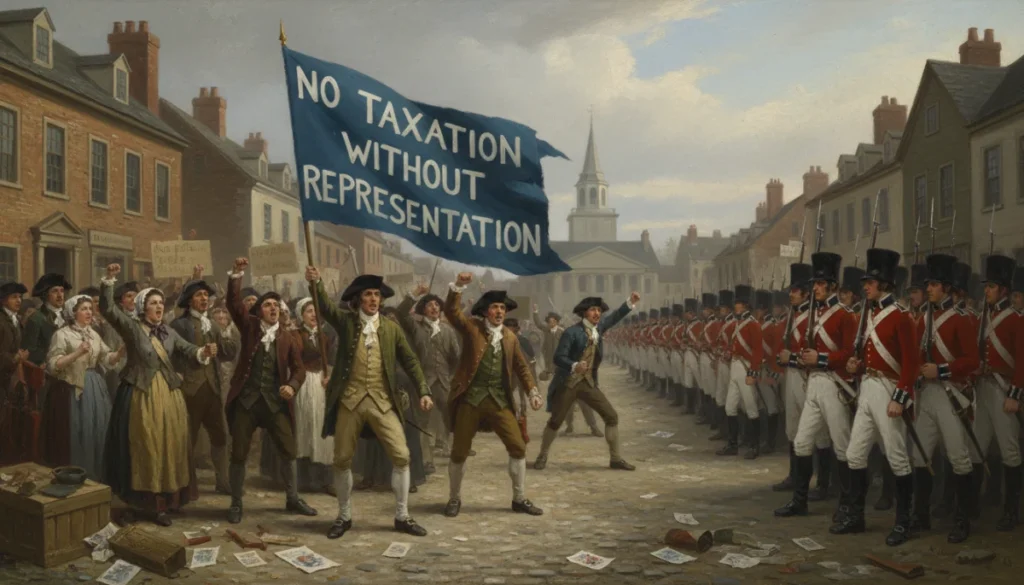
The cry of “No Taxation Without Representation!” became a rallying point for American colonists, encapsulating their profound frustration with British economic policies. For decades, the colonies had largely managed their own internal affairs, including taxation. However, after the costly French and Indian War, Britain sought to recoup its expenses by directly taxing the colonies, a move seen as a blatant disregard for colonial rights.
This grievance was not merely about the financial burden of taxes; it was about the principle of consent. Colonists believed that only their elected colonial assemblies had the authority to levy taxes upon them. The British Parliament, where colonists had no direct representatives, was perceived as overstepping its bounds and imposing laws without the input or approval of those most affected.
The burden of new taxes
A series of acts passed by Parliament aimed at increasing revenue from the colonies, each met with escalating resistance. These acts were viewed as oppressive and illegitimate.
The Sugar Act (1764): Imposed duties on molasses and other goods, aiming to curb smuggling and raise revenue.
The Stamp Act (1765): Required a stamp on all legal documents, newspapers, and playing cards, affecting nearly every colonist.
The Townshend Acts (1767): Placed duties on imports like glass, lead, paper, and tea, and established new customs collection mechanisms.
The colonists argued that these taxes were not for regulating trade, which they generally accepted, but purely for revenue, and thus unconstitutional without colonial representation. This distinction was vital to their argument, highlighting the perceived shift in British policy from mercantilism to direct financial extraction.
The core issue of taxation without representation directly challenged the colonists’ understanding of their rights as Englishmen. They believed in the British tradition of parliamentary consent for taxation, a right they felt was being denied to them across the Atlantic. This fundamental disagreement laid the groundwork for further conflict and solidified the belief that their voices were not being heard in London.
Quartering of British troops: an affront to privacy
The presence and quartering of British soldiers in colonial homes and public buildings represented a significant intrusion into the daily lives of colonists and a direct challenge to their civil liberties. Following the French and Indian War, Britain maintained a standing army in America, ostensibly for protection against Native American tribes and potential French resurgence. However, many colonists viewed this military presence with deep suspicion, seeing it as a tool for enforcing unpopular British policies and suppressing dissent.
The Quartering Acts, passed by Parliament, mandated that colonists provide housing, food, and supplies for British soldiers. This was not merely an inconvenience; it was perceived as a violation of their rights to privacy and property, reminiscent of practices under despotic regimes rather than a free British government. The financial burden and the constant presence of armed soldiers created an atmosphere of tension and resentment.
Acts that fueled resentment
Specific legislative actions intensified colonial anger over quartering.
The Quartering Act of 1765: Required colonial assemblies to provide housing and provisions for British troops.
The Quartering Act of 1774 (part of the Intolerable Acts): Expanded the scope, allowing British commanders to quarter soldiers in private homes if other barracks were unavailable.
These acts were seen as a direct assault on the sanctity of their homes and their autonomy. The idea of housing soldiers who were there, in part, to enforce laws the colonists deemed unjust, was particularly galling. It fostered a sense of being occupied rather than protected, eroding trust in British authority.
The forced quartering of troops was more than just an economic burden; it was a constant, visible reminder of British power and the colonists’ diminished status. It stripped away a sense of personal security and contributed significantly to the growing anti-British sentiment, making the British military an unwelcome presence rather than a guardian.
Restrictions on trade and commerce: stifling economic growth
British mercantilist policies, though long-standing, became increasingly burdensome and restrictive on colonial trade and commerce, ultimately stifling economic growth and fostering resentment. While the colonies were initially established to benefit the mother country, the tightening of trade regulations after the French and Indian War was seen as an unfair exploitation of colonial resources and labor. These policies dictated what the colonies could produce, whom they could trade with, and how their goods were transported, all to Britain’s advantage.
The Navigation Acts, a series of laws enacted over a century, were designed to ensure that the colonies served as a source of raw materials for Britain and a market for British manufactured goods. While initially loosely enforced, the post-war period saw a stricter application, limiting colonial merchants’ ability to compete and innovate.
Key trade regulations
Several acts directly impacted colonial economic aspirations.
Navigation Acts: Required most colonial goods to be shipped to England first, often incurring additional duties.
Molasses Act (1733): Placed high tariffs on molasses imported from non-British colonies, although widely circumvented through smuggling.
Sugar Act (1764): A stricter enforcement of molasses duties, aimed at both revenue and curbing illegal trade.
These restrictions prevented colonies from developing their own industries and engaging in more profitable trade with other nations. Colonial merchants felt handicapped, unable to pursue economic opportunities that would benefit their communities. The perception grew that Britain viewed the colonies solely as a means to enrich itself, rather than as equal partners in the empire.
The economic grievances created by these trade restrictions were profound. They limited colonial prosperity, fostered illicit trade, and generated a deep-seated frustration among merchants and farmers alike. This economic subjugation was a powerful motivator for seeking greater autonomy and, eventually, independence.
Lack of self-governance and political autonomy: erosion of rights
The erosion of self-governance and political autonomy was a critical grievance that fueled the colonial desire for independence. For many years, the colonies had enjoyed a significant degree of self-rule, with their own elected assemblies making laws and managing local affairs. This tradition of salutary neglect allowed a distinct American political identity to flourish, based on republican ideals and a belief in local control. However, after 1763, Britain began to assert greater direct control over colonial governance, dismantling the established order and provoking widespread alarm.
Parliamentary acts and royal decrees increasingly bypassed colonial legislatures, imposing decisions from afar without colonial input. This shift was viewed as a direct attack on the colonists’ rights as Englishmen, who believed in the importance of representative government and the protection of their liberties against arbitrary rule.
British attempts at control
Various measures demonstrated Britain’s intent to centralize power.
Proclamation of 1763: Restricted westward expansion, angering land-hungry colonists.
Appointment of Royal Governors: Governors often clashed with colonial assemblies, dissolving them or vetoing their legislation.
Declaratory Act (1766): Asserted Parliament’s right to legislate for the colonies “in all cases whatsoever,” negating colonial legislative authority.
The colonists saw these actions as a concerted effort to reduce them to mere subjects without the rights and privileges enjoyed by those in Britain. The idea that a distant Parliament could dictate their laws and undermine their elected bodies was an unacceptable infringement on their political freedom. This constant struggle for control over their own affairs galvanized colonial leaders and the populace.
The struggle for self-governance was not just about practical administration; it was about the fundamental right of a people to determine their own destiny. The British attempts to strip away colonial political autonomy directly challenged the very essence of American identity and fostered a deep-seated conviction that only complete independence could secure their liberties.
Admiralty courts and denial of jury trials: undermining justice
The establishment and expansion of admiralty courts, coupled with the denial of trial by jury, represented a severe blow to the colonists’ understanding of justice and due process. Traditionally, British common law guaranteed the right to a trial by a jury of one’s peers. However, admiralty courts, which operated without juries, were increasingly used to try colonists accused of violating British trade laws and revenue acts. These courts were presided over by a single judge, often a royal appointee, who had a financial incentive to find defendants guilty, as fines often went to the crown and the judge himself.
This system was perceived as fundamentally unfair and a deliberate attempt to circumvent colonial juries, which were often sympathetic to local merchants and smugglers. The absence of a jury meant a loss of a critical check on governmental power and an erosion of a basic right that colonists cherished as Englishmen.
The threat to legal rights
The use of admiralty courts was particularly egregious in certain contexts.
Enforcement of Revenue Acts: Cases involving violations of the Sugar Act, Stamp Act, and Townshend Acts were often tried in admiralty courts.
Lack of Local Sympathy: Judges were not from the local community and were often biased towards the Crown, making fair trials unlikely.
Burden of Proof: Defendants often had to prove their innocence, reversing the common law principle of innocent until proven guilty.
The denial of trial by jury was not just a procedural change; it was a symbolic act that demonstrated Britain’s willingness to disregard fundamental legal protections in its pursuit of control and revenue. Colonists viewed this as a tyrannical overreach, undermining the very foundation of their legal system and making them vulnerable to arbitrary judgments.
The legal grievances stemming from admiralty courts and the denial of jury trials highlighted the growing disparity between British legal practices and colonial expectations. This attack on their judicial rights further alienated the colonists and reinforced their belief that their liberties were under constant threat from an increasingly authoritarian Parliament.
Standing armies in peacetime: a symbol of oppression
The presence of standing armies in the colonies during peacetime was a constant source of anxiety and a powerful symbol of British oppression. After the French and Indian War, Britain decided to maintain a significant military presence in North America, ostensibly for defense. However, colonists viewed these troops not as protectors, but as instruments of control, enforcing unpopular laws and suppressing dissent. The very idea of a standing army in peacetime was anathema to British political tradition, which held that such forces were a threat to liberty.
The expense of maintaining these troops often fell, in part, on the colonial assemblies through acts like the Quartering Act, further exacerbating financial grievances. The sight of armed soldiers patrolling their towns and cities created an atmosphere of intimidation and suspicion, transforming once-loyal subjects into wary adversaries.
Incidents of military tension
The presence of troops led to several flashpoints.
Boston Massacre (1770): British soldiers fired into a crowd of unarmed colonists, killing five.
Lexington and Concord (1775): The first military engagements of the Revolutionary War, sparked by British attempts to seize colonial arms.
Constant Vigilance: The daily presence of soldiers meant constant friction and potential for conflict, eroding civil trust.
The colonists believed that a standing army was a tool of tyranny, used to enforce the will of a distant government rather than to protect the rights of the people. They saw it as a direct threat to their freedom and a violation of the principles of a free society. This sentiment was deeply ingrained in the colonial psyche, drawing on centuries of British constitutional thought that warned against unchecked military power.
The presence of standing armies in peacetime was a tangible manifestation of British imperial overreach. It transformed abstract political disagreements into concrete, daily realities for colonists, fueling their resolve to resist. This grievance underscored the growing conviction that their liberties could only be secured by removing British military and political control entirely.
Key Grievance
Brief Description
Taxation Without Representation
Parliament imposed taxes without colonial consent or representation, violating fundamental rights.
Quartering of Troops
Colonists were forced to house British soldiers, infringing on privacy and property rights.
Trade Restrictions
Mercantilist policies stifled colonial economic growth and limited trade opportunities.
Lack of Self-Governance
Britain asserted direct control, eroding colonial assemblies’ power and political autonomy.
Frequently asked questions about colonial grievances
What was the primary grievance leading to the American Revolution?▼
The primary grievance was “Taxation Without Representation.” Colonists believed that the British Parliament had no right to levy taxes on them without their direct consent or representation in Parliament, violating their fundamental rights as Englishmen.
How did the Quartering Acts contribute to colonial discontent?▼
The Quartering Acts forced colonists to house and provide for British soldiers. This was seen as a profound intrusion on their personal liberties and property rights, fostering resentment against the standing army in peacetime.
Why were trade restrictions a major complaint for the colonists?▼
British mercantilist policies, like the Navigation Acts, limited colonial trade to benefit Britain, stifling colonial economic growth. Colonists resented being unable to freely trade with other nations or develop their own industries.
What was the significance of admiralty courts in colonial grievances?▼
Admiralty courts tried colonists without a jury for violating trade laws. This denied colonists their right to a trial by peers, a fundamental British legal protection, making justice seem biased and unfair in the eyes of the accused.
How did the concept of self-governance clash with British policy?▼
Colonists had developed robust self-governing assemblies, but Britain asserted greater direct control after 1763. This erosion of political autonomy, epitomized by acts like the Declaratory Act, directly challenged their established rights and traditions.
Conclusion
The journey from Jamestown to 1776 was a complex interplay of evolving colonial identity and increasingly assertive British imperial policy. The six core grievances—taxation without representation, the quartering of troops, trade restrictions, lack of self-governance, denial of jury trials, and standing armies in peacetime—were not isolated incidents but interconnected challenges to colonial liberty and prosperity. Each grievance chipped away at the colonists’ loyalty to the Crown, fostering a profound sense of injustice and a growing conviction that their rights as Englishmen were being systematically denied. Ultimately, these grievances culminated in a revolutionary fervor, compelling the colonies to declare independence and forge a new nation founded on the principles of self-determination and individual liberty.